
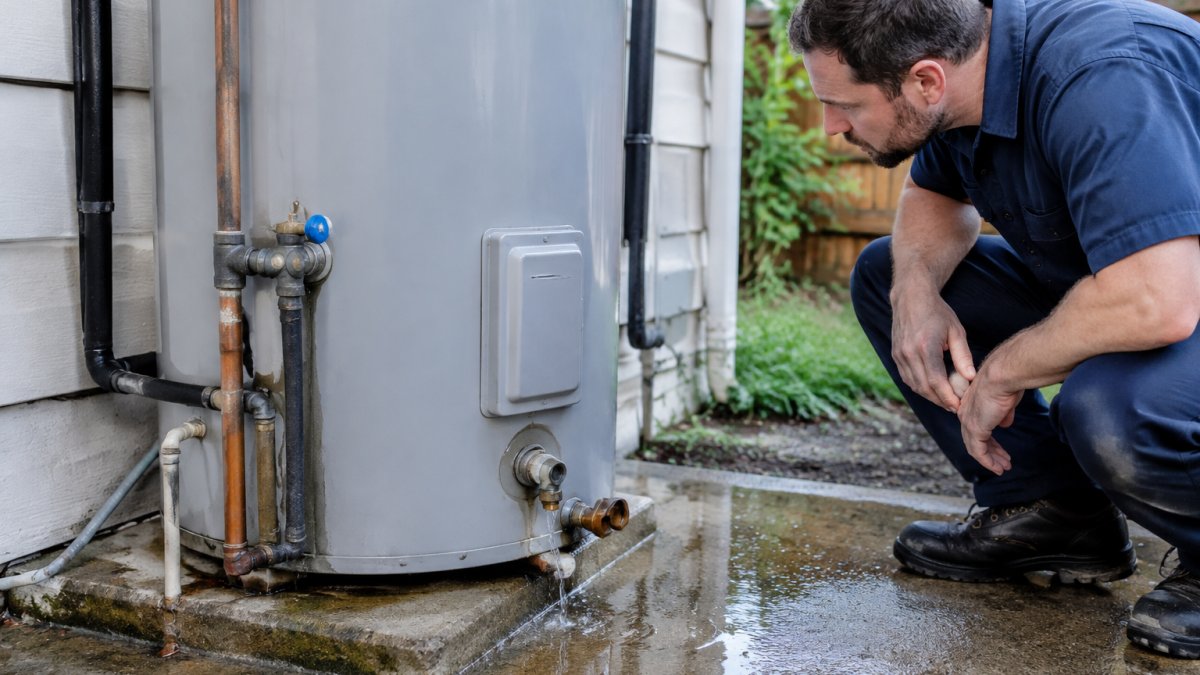
7 Reasons Your Hot Water System Leaks From the Bottom
Last Updated: November 5, 2026
Quick Summary
A hot water system leaks from the bottom when water pools under the tank, but the tank itself is not always the cause. Water from a loose fitting, dripping valve or split hose can run down the cylinder and gather at the base, so dry the floor and check above the puddle for streaks or damp pipework before assuming the tank has failed.
- Dry the floor and tank base, wait 20 to 30 minutes, then check for streaks or damp pipework above the puddle.
- Seven faults account for most bottom leaks: faulty drain valve, perished seals, T&P valve discharge, excess pressure, tank corrosion, loose fittings and failed element gaskets.
- An internal tank leak from corrosion cannot be repaired, so replacement is the only option once the steel gives way.
- Switch off the circuit breaker for electric systems or the gas isolation valve for gas systems before assessing the leak.
- A drain valve or seal repair usually takes under an hour, while a standard tank replacement takes three to four hours.
Table of Contents
- Is It Really a Bottom Leak? How to Trace the Source
- Hot Water System Leaking From the Element: What It Means
- Hot Water System Repair or Replacement: How to Decide
- How Long Does Hot Water System Repair Take?
- Book a Same-Day Leak Assessment
- Frequently Asked Questions
Is It Really a Bottom Leak? How to Trace the Source
Water pooling at the base is not proof of a hole in the tank.
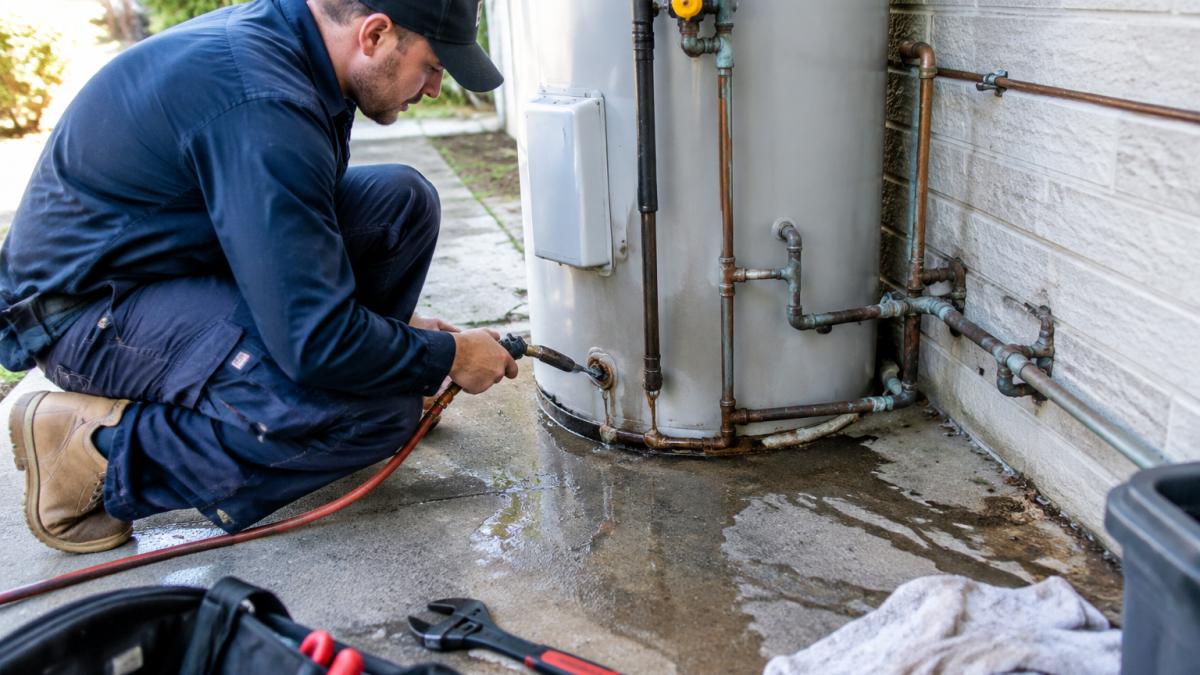
So trace it before you panic:
- Dry the floor and the base of the tank with a towel.
- Wait 20 to 30 minutes and check again.
- Look above the puddle for streaks, crusty white marks or damp pipework.
If the water returns directly under the tank with no trail above, the tank is the likely source.
(/book/repair-fault-diagnosis) with our licensed team. For a burst or badly leaking tank, [same-day emergency hot water callout](/book/emergency-callout) is the faster route.Hot Water System Leaking From the Element: What It Means
A hot water system leaking from the element is usually a failed element gasket, not a failed tank.
Electric systems have this fault most often. The fix is usually straightforward: drain the tank, replace the gasket or the element, and refill.
If your system also runs cold mid-shower, that points to the same area. Our guide on how to stop hot water going cold mid-shower covers the related symptoms.
Hot Water System Repair or Replacement: How to Decide
The decision usually comes down to three questions: is the tank itself sound, is the fault in a replaceable component, and does the age and warranty position make repair worthwhile? Work through them in that order.
What is commonly repairable
Most bottom leaks are not tank failures. These components are routinely repaired or replaced by a licensed plumber:
- Drain valve and washers: a worn washer or perished seal is a quick, low-cost fix.
- T&P valve: a valve that discharges constantly can often be replaced, and the underlying high pressure addressed with a pressure limiting valve.
- Element and element gasket: on electric systems, the gasket and element are replaceable once the tank is drained.
A common pattern is that a leak traced to one of these components is fixed in a single visit, provided the part is available.
When tank corrosion means replacement
An internal tank leak from corrosion cannot be repaired. Once the steel liner gives way, water escapes through the tank body and no sealant or patch will hold. Signs that point to replacement rather than repair include:
- Rusty or discoloured hot water at the tap
- Water seeping from the tank body itself, with no trail above
- A damp base that returns after drying, with no wet fitting or valve nearby
If two or more of these apply, replacement is usually the better spend. A rusty tank does not heal, and patching a corroded cylinder only delays the inevitable.
What affects the cost
The final cost depends on the fault, the part, access to the system and the system type. Pricing depends on the specific work required, and a quote can be requested for current prices. Parts availability matters too: common brands such as Rinnai, Rheem and Dux are usually stocked locally, while rare models can mean a wait.
Warranty and age considerations
Check the system's warranty before deciding. Many storage tanks carry a warranty period that covers the cylinder but not labour, and the terms vary by brand and model. Check the warranty terms with the manufacturer or retailer to see what may be covered. If the system is past its service life, putting money into a repair may not be the best use of it.
System type changes the decision
- Storage tanks: the repair-or-replace logic above applies most directly.
- Tankless (continuous flow) systems: these have no storage tank to corrode, so a bottom leak is more likely to be a fitting, condensation or internal component issue. Repair is often the first option.
- Heat-pump systems: the tank and the heat-pump unit are separate considerations. A leak from the tank side follows storage-tank logic; a fault in the heat-pump module is a different repair path.
If replacement is the call, you can look at replacement options with a licensed plumber. Our article on the five signs your hot water system needs replacing walks through each warning sign in more detail.
How Long Does Hot Water System Repair Take?
Repair times depend on the fault and access to the system. A drain valve or gasket swap is usually quick. A corroded tank is not a repair at all, and replacement takes longer.
Here is how it breaks down:
- Drain valve or seal: under an hour
- Element or gasket: one to two hours, including drain and refill
- Pressure valve or fittings: one to two hours
Parts availability can affect timing. Rare models may mean a wait for parts.
Book a Same-Day Leak Assessment
A bottom leak will not fix itself, and the longer water sits under the tank, the more damage it does to the base, the slab and nearby walls.
Call Northern Rivers Hot Water and we will trace the leak, tell you whether it is a repair or a replacement, and get your hot water back on.
Frequently Asked Questions
Is a hot water system leaking from the bottom dangerous?
It can be. Water near the electrical element or wiring creates a shock risk, and a tank at full temperature poses a scalding risk if it splits. Gas units leaking near the burner assembly are also a concern. Treat any bottom leak as urgent: isolate power at the switchboard, shut the water off at the isolating valve, and turn off the gas supply if you have a gas system, then call a licensed plumber. Do not stand in pooled water while touching the system.
Can a hot water system leaks from the bottom be repaired, or does it need replacing?
It depends on the source. A worn drain valve, a perished element gasket, a loose fitting or a failed T&P valve can usually be repaired on the spot. An internal tank leak from corrosion cannot be repaired and means replacement. The deciding factor is whether the water is coming from a fitting on the outside of the tank or weeping through the tank wall itself, which a licensed plumber can confirm during a hot water system repair or replacement assessment.
Should I turn off my hot water system if it is leaking?
Yes. Switch off the power at the circuit breaker or isolator, close the cold water isolating valve on the inlet, and shut the gas supply if applicable. This limits water damage and removes the electrical and scalding hazards while you wait for a plumber. If the leak is heavy or the tank is hissing or bulging, keep everyone clear of the area and call for same-day help rather than attempting further checks yourself.
How long does hot water system repair take for a bottom leak?
A straightforward fix such as a drain valve, element gasket or fitting replacement usually takes one to two hours once the plumber is on site. If the tank is corroded and the unit needs replacing, the job takes longer than a simple repair. A licensed plumber can give a timeframe once they have assessed the system.

Need help with your hot water system?
Call Northern Rivers Hot Water for a free, no-obligation quote. We service Lismore, Ballina, Byron Bay, Casino and all surrounding areas.
0472 580 441