
How to Increase Hot Water Tank Capacity: A Practical Guide
Quick Summary
Hot water tank capacity is often not the real limit; usable hot water depends on tank volume, stored temperature and how much cold water is mixed in before it reaches the tap. Check for faults first, then raise usable volume with a booster, a larger tank or a second tank, or reduce peak demand.
- Usable hot water depends on stored temperature, delivery temperature and mixed-water volume, not tank size alone.
- Troubleshoot faults such as a failed element, thermostat or sediment before buying more capacity.
- Raising stored temperature by 10°C adds about 90 litres of usable mixed water from a 250-litre tank.
- A hot water booster raises usable output without replacing the tank, but it needs a correctly set mixing valve.
- Compare peak-hour demand with usable volume and recovery rate before choosing a booster, larger tank or second tank.
Table of Contents
- How to Increase Hot Water Tank Capacity: A Practical Guide
- Why Your Hot Water Runs Out: Tank Capacity Versus Usable Volume
- Troubleshoot Before You Add Capacity
- How a Hot Water Booster Increases Usable Capacity
- Working Out Your Hot Water Tank Size With Worked Examples
- Booster, Larger Tank, Second Tank or Demand Fixes: Which to Choose
- Installing a Larger Hot Water Tank: Preparation and Steps
- Book a Capacity Check Before You Buy a New System
- Frequently Asked Questions
How to Increase Hot Water Tank Capacity: A Practical Guide
Last Updated: November 8, 2026
Why Your Hot Water Runs Out: Tank Capacity Versus Usable Volume
When hot water runs out mid-shower, tank size is often not the issue. Usable hot water depends on tank volume, stored temperature, and how much cold water mixes in before it reaches your tap.
Most Northern Rivers homes have a storage tank holding a fixed volume, typically heated to 60°C to 75°C. Water is only usable at the temperature you want at the tap, usually 40°C to 50°C, so your plumbing blends stored hot water with cold.
Stored temperature, delivery temperature and mixed-water volume
The key to understanding capacity is three numbers:
- Stored temperature: how hot the water sits in the tank
- Delivery temperature: how hot you want it at the tap
- Mixed-water volume: how much usable water results after cold water is blended in
A higher stored temperature means more usable water from the same tank, and a lower delivery temperature does the same. Raising stored temperature is one of the simplest ways to get more from an existing system, but it must be done with care to avoid scalding.
Troubleshoot Before You Add Capacity
Before buying a bigger tank, check whether the system is working as it should. A failing element, faulty thermostat or sediment build-up can make it look like you have too little capacity.
Check these common issues first:
- Lukewarm water quickly: often a failed heating element or thermostat
- Rusty or discoloured water: can signal a corroding tank or failing anode rod
- Noisy tank: usually sediment settling and heating unevenly
A licensed plumber can diagnose these faults quickly. Fixing a fault restores the capacity you already have, which is often cheaper than adding more. A licensed plumber can check your system and advise whether a repair or a capacity change makes more sense.
How a Hot Water Booster Increases Usable Capacity
A hot water booster, sometimes called a tank booster, raises the usable output of an existing tank without replacing it. It heats stored water to a higher temperature, then uses a mixing valve to blend it back down to a safe delivery temperature.
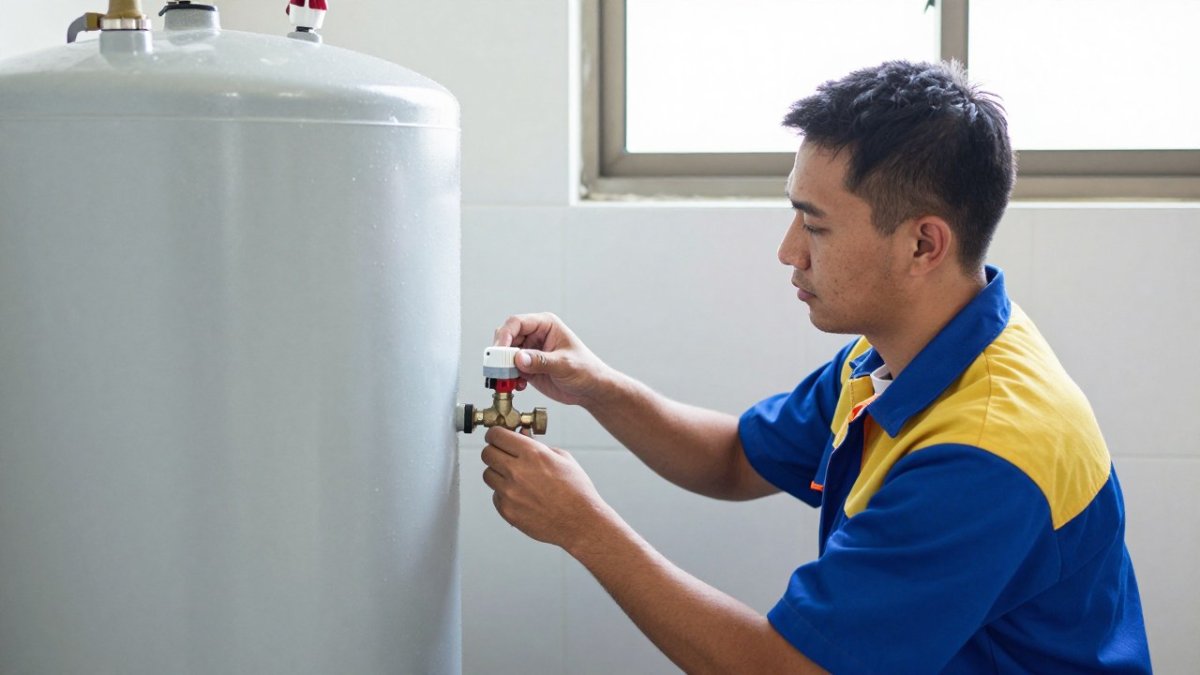
The booster is a small unit that works alongside your existing system, suiting households whose tank is adequate in size but whose usable volume is too low.
How a thermostatic mixing valve works and its safety limits
A thermostatic mixing valve (TMV) sits on the outlet of your hot water system and blends hot and cold water to hold a set delivery temperature, letting the tank run hotter without sending scalding water to your taps.
There are limits you must respect:
- The valve must be correctly set and regularly checked
- Stored temperatures above 60°C raise the risk of Legionella if the water is not managed properly
- Delivery temperature at the tap should not exceed safe levels for bathing, especially for children and older people
Always follow the relevant Australian standards and local plumbing regulations when setting temperatures (Part B2 Heated water services). If unsure, have a licensed plumber set the valve and confirm the outlet temperature.
Working Out Your Hot Water Tank Size With Worked Examples
To know whether you need more capacity, you need two numbers: how much mixed water your household draws at peak time, and how much mixed water your tank can actually deliver.
Step 1: Estimate peak-hour demand
Add up the mixed water used by each fixture during your busiest hour, using flow rate and duration rather than tank size.
Example for a family of four, morning peak:
- Two showers at 9 L/min for 7 minutes each: 126 litres of mixed water
- One dishwasher cycle: about 10 litres of hot water draw (the machine mixes its own cold)
- Hand basin and kitchen tap use over the hour: about 15 litres
That is roughly 150 litres of mixed water in the peak hour, mixed water at the tap, not hot water from the tank.
Step 2: Convert stored hot water into usable mixed water
The volume of mixed water a tank can deliver depends on three temperatures:
The mixing relationship is a simple energy balance. Mixing V_hot litres of stored water at T_store with V_cold litres of cold water at T_cold to reach T_delivery gives:
V_hot × (T_store − T_delivery) = V_cold × (T_delivery − T_cold)
Total mixed volume V_mixed = V_hot + V_cold.
A more direct form: for every litre of stored hot water, the mixed volume you get is (T_store − T_cold) ÷ (T_delivery − T_cold).
Worked example A, 250 L tank at 60°C, cold water at 15°C, delivery at 42°C:
- Mixing ratio = (60 − 15) ÷ (42 − 15) = 45 ÷ 27 = 1.67
- Usable mixed volume = 250 × 1.67 = about 417 litres
Worked example B, same tank raised to 70°C:
- Mixing ratio = (70 − 15) ÷ (42 − 15) = 55 ÷ 27 = 2.04
- Usable mixed volume = 250 × 2.04 = about 509 litres
Worked example C, winter cold water at 8°C, tank at 60°C, delivery at 42°C:
- Mixing ratio = (60 − 8) ÷ (42 − 8) = 52 ÷ 34 = 1.53
- Usable mixed volume = 250 × 1.53 = about 382 litres
Cold inlet temperature matters.
These calculations assume the tank is fully heated to the set temperature and that draw is steady.
Step 3: Compare usable volume with peak demand, then check recovery
If your calculated usable mixed volume is below your peak-hour demand, you have a capacity gap.
A common pattern is a tank that passes the volume test on paper but fails in practice because recovery is slow relative to morning demand. If two showers run back-to-back and the element cannot reheat between them, the second draws on already-depleted hot water.
Step 4: Decide whether the gap is real
Run the calculation with your actual thermostat setting, seasonal cold-water temperature and measured peak demand. A small gap may close with demand fixes; a large gap points to a booster, larger tank or second tank.
Booster, Larger Tank, Second Tank or Demand Fixes: Which to Choose
Each option solves a different problem. The right choice depends on whether your gap is in usable volume, total storage, recovery rate or timing, and on your space, plumbing and budget.
Match the option to the gap
| Option | Best when | Main limitation | Installation constraint |
|---|---|---|---|
| Hot water booster (TMV retrofit) | Tank size is adequate but usable volume is low; stored temperature can be safely raised | Depends on existing tank and heating capacity; needs a TMV and safe delivery temperature | Requires a licensed plumber to set and commission the valve |
| Larger tank | Household demand has genuinely outgrown storage; tank is old or due for replacement | Needs space, suitable access and often upgraded pipework or electrical/gas supply | May require structural or clearance checks |
| Second tank | Demand is high or spread across distant outlets; one tank cannot serve both ends of the home | Higher upfront cost, more standing heat loss and more plant space | Needs additional plumbing runs and controls |
| Demand fixes | Gap is small or concentrated in a short peak window | Changes habits rather than adding supply; limited headroom | Low cost, no plumbing work |
The decision sequence
- Troubleshoot first. If the tank used to keep up and now does not, the gap may be a fault (sediment, element, thermostat, dip tube) rather than capacity. Fix that before spending on capacity.
- Quantify the gap. Use the mixed-water calculation in the previous section. If usable mixed volume is close to peak demand, demand fixes may be enough. If it is well short, move to supply-side options.
- Check recovery rate. If the tank recovers slowly, a booster or larger tank may not fix back-to-back use on its own; recovery capacity matters as much as volume.
- Check installation constraints. Space, access, flue or electrical capacity and pipework condition often rule out a larger or second tank before cost does.
- Compare whole-of-life cost, not sticker price. A larger tank or second tank carries higher upfront cost plus ongoing standing heat loss. Demand fixes are cheapest but only close small gaps.
What each option actually changes
- Booster: raises stored temperature and blends down at the outlet, increasing usable mixed volume from the same tank. It does not increase the tank's physical storage or its recovery rate.
- Larger tank: increases both stored volume and, usually, recovery capacity, because larger units typically have larger heating elements or burners. It is the most complete fix but the most disruptive.
- Second tank: adds storage and can shorten pipe runs to distant outlets, but doubles standing losses and plant space.
Cost and energy trade-offs
Pricing depends on tank type, access and whether electrical or gas work is needed, so request a quote from Northern Rivers Hot Water through its website for current prices. On energy, raising stored temperature increases standing heat loss, and a second tank adds a second source of standing loss, so the cheapest option to buy is not always the cheapest to run.
Safety and compliance
Any change to stored or delivery temperature must respect scald-prevention requirements and the relevant Australian standards and local plumbing regulations. A TMV must be correctly set and commissioned by a licensed plumber, and stored temperatures must be managed to control Legionella risk.
Watch out: a booster set up without a correctly commissioned TMV can deliver scalding water at the tap, especially to children and older people. Have the valve set and the outlet temperature checked before use.
Installing a Larger Hot Water Tank: Preparation and Steps
Replacing a tank with a larger one is a job for a licensed plumber. Gas and electrical work must be done by qualified tradespeople, and the job often requires shutting off power, fuel and water first.
Typical preparation includes:
- Confirm the space and access for the new tank
- Shut off the power, gas or LPG supply at the isolating point
- Close the cold water supply to the tank
- Drain the tank and check the pipe connections
- Install the new tank and connect the pipework, including any mixing valve
- Refill, purge air from the lines and test for leaks
Check the tank size, connection points and compliance requirements before you buy. A plumber can confirm whether your existing pipework, such as CPVC pipe, is suitable for the new installation.
Book a Capacity Check Before You Buy a New System
Buying the wrong system is an expensive mistake.
Book a Hot Water Service, Book a hot water service online for annual checks, electric storage, LPG, emergency callouts and repairs across the Northern Rivers.
Ready to get more hot water? Choosing the right system matters. Contact Northern Rivers Hot Water through its website to discuss your household's needs and request a quote.
Frequently Asked Questions
Can you increase the capacity of an existing hot water tank?
You cannot change the physical volume of an existing tank, but you can increase the usable hot water you get from it. A tempering or mixing valve blends stored hot water with cold to deliver more mixed water per tank, and reducing peak demand, such as staggering showers, has a similar effect. If the tank is too small for the household's peak demand, the lasting fix is a larger unit, and a licensed plumber can assess which option suits your home.
Will turning up the thermostat give you more usable hot water?
Raising the thermostat heats the stored water to a higher temperature, which can increase the amount of mixed water available for a given draw, because hotter stored water needs less cold water to reach a comfortable shower temperature. However, the stored volume does not change, and higher temperatures increase scald risk and energy use. Any temperature change should be set with a licensed plumber, who can also confirm the safe delivery temperature for your system.
Is it better to install a larger hot water tank or a booster?
A booster suits homes where the tank is adequate but the usable volume falls short during peak use. A larger tank is the better choice when the household regularly exhausts the stored supply, or when recovery rate is too slow to refill between uses. Cost, energy use and payback vary with your system and household, so ask Northern Rivers Hot Water for a quote before deciding.
Why does my hot water run out faster than it used to?
Common causes include a sediment build-up that reduces the heated volume, a failing heating element or thermostat, a mixing valve set incorrectly, or an increase in household demand such as new appliances or more occupants. Check the thermostat setting and look for leaks or corrosion before assuming the tank is too small. If the problem persists, a plumber can test the elements and thermostat and calculate whether capacity is the real issue.

Need help with your hot water system?
Call Northern Rivers Hot Water for a free, no-obligation quote. We service Lismore, Ballina, Byron Bay, Casino and all surrounding areas.
0472 580 441